80 Million Years of Earth History Is Packed Into This 0.25-Mile Oregon Trail That Most Visitors Completely Miss
At the Painted Hills you come for the colors—but you leave with a sense of scale, and long, slow perspective.
Just stepping off-trail can leave a mark that lasts for decades, even centuries, scarring a landscape that took millions of years to form.
When you first see the Painted Hills it looks like a painting—bands of red, ochre, gold, and black sweep across the Oregon mounds in surreal, undulating patterns. These colors wouldn’t usually exist together in nature, but somehow make perfect sense here.
And they pop. Here, they’re given the space to. Though the Painted Hills are just one of three units in the 14,000 acre John Day Fossil Beds National Monument—besides the Sheep Rock and Clarno Units—this one feels the most cinematic. On this side of the Cascades that sees more than 200 days of sunshine, outdoors isn’t just pleasant, it’s immersive. And with the layers of geologic history under your feet, it’s virtually time travel.
It’s easy to forget what year it is. There’s no Wi-Fi or cell service. The closest town is Mitchell, population of nearly 150, founded in 1873—a blink-and-you’ll-miss-it kind of place, straight out of an old Western, with saloon-style sun-bleached wooden storefronts. Each summer they host a Painted Hills Festival, a community affair with a parade, performances, quilt show, pie auction, half marathon and something called water trough racing.
The Painted Hills Unit offers five trails. The most popular, understandably, and the one where you should definitely start is the classic Painted Hills Overlook, a mellow 0.5-mile round-trip walk that gently traces a ridge just above the striped mounds. It’s ideal for anyone wanting to soak in the surreal beauty, and a dream for photographers chasing that golden hour shot.
We drive up around midday. The path is bustling, filled with people crawling antlike up and down the trail. Spring wildflowers add extra color to the palette and the air is scented with sagebrush. On one of the mounds, I spot animal footprints—likely from deer or coyotes that passed through when the ground was still damp. But more troubling are the sharp, unmistakable imprints of human shoes, veering off trail where they shouldn’t be.
Because here’s the thing: while the Painted Hills are absolutely stunning, you can’t actually climb them, and truthfully, you wouldn’t want to. These hills are protected as part of a fragile ecosystem. Their vibrant layers are made of soft, clay-rich soils formed from ancient volcanic ash and the surface is incredibly delicate and especially prone to erosion. Just stepping off-trail can leave a mark that lasts for decades, even centuries, scarring a landscape that took millions of years to form.
However for geology buffs or those just looking for a cool photo, there are a few other ways to get close to the action, each with a unique perspective.
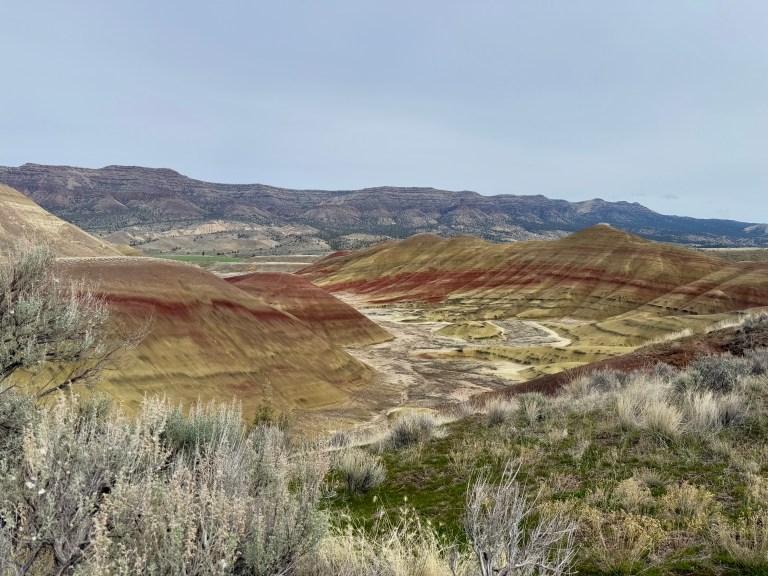
The Painted Hills are known as one of Oregon's Seven Wonders, which also include the Oregon Coast, Columbia River Gorge, and Mount Hood. I personally wore the Painted Hills before I ever saw them, they’re so famous they inspired a shoe (by Danner, an Oregon brand). The Northern Paiute people, most likely the first to see the hills as they came through on seasonal migrations, attributed the deep red color to blood. According to their lore, a battle of wits between a mean giant and a clever coyote resulted in the coyote tricking the giant by slipping off his hide, and blood being splattered across the land, resulting in deep red soils. The coyote turned the giant into stone, and the result is Monkey Face, a 350-foot spire at Smith Rock State Park that does, remarkably, look like a monkey.
The geologic explanation for the colors is no less dramatic, but the action took much, much longer. Layers of ash were created from volcanic eruptions over time, each strata subjected to different climates and temperatures, from tropical to temperate, resulting in a rainbow of colors. The spectacular red hills are colored, in part, by iron oxides—within the layers is a fossilized sequence of life evolving, adapting, and migrating as the landscape was transformed over millions of years. (The Thomas Condon Visitor Center at the Sheep Rock Unit can elucidate, with artifacts taking you on the 55 million journey preserved in the surrounding fossil beds.)
But they’re also just flat-out cool to look at. Beyond the Overlook Trail, the 1.6-mile Carroll Rim Trail offers a sweeping, elevated view of the entire area. The shorter Leaf Hill Trail and Red Scar Knoll Trail—each just 0.25 miles—also provide unique vantage points. But if there’s only one other trail to do, make it the Painted Cove Trail. Easily accessible, at just .25 miles with an elevated boardwalk, this one immerses you right in the action.
Ever seen purple gravel? You will here. The trail winds through a vibrant pocket of the hills where cracked red clay fades into lavender-grey and streaks of green tuck into soft gold. There are parts where the mounds rise up to the sides of you and it feels like you’re the only person on Earth, but here, it’s more akin to being on Mars. Shy lizards disappear into the rocks. One sign explains that the lavender-grey layer is part of a rhyolitic lava flow—older even than the Painted Hills themselves.

It just reiterates that these grounds have been shaped grain by grain over a stretch of time barely comprehensible to the human mind. A visit is less sightseeing and more like flipping through a photo book, and leaving with some of the memories stuck in your hiking boots. At the Painted Hills you come for the colors—but you leave with a sense of scale, and long, slow perspective.
And if you want some action, there’s always water trough racing.
Subscribe to our newsletter
Get the latest updates and news
Thank you for subscribing!