Locals Will Never Forget Their First Time Visiting Kīlauea In Hawaii
Kīlauea, the most active volcano in Hawaii, offers a fascinating glimpse into the island's geological and cultural history.
Hawaii is a lush paradise, until you wander into a landscape that's suddenly rather barren. Locals are familiar with the destruction brought on by volcanoes, but tourists are endlessly fascinated by these geological wonders. Though they're mundane to us residents, we have to stop and marvel every so often that these volcanoes have spent 70 million years creating the Hawaiian–Emperor seamount chain underwater mountain range. Just like tourists, we can't help but recall our first visit to Kīlauea in the Hawaiian Islands fondly. After all, it's the most active of the local volcanoes, and it's a magnificent site to see. Check it out:
Hawaiʻi is the largest island in the U.S. state of Hawaii, and it is built of five distinct volcanoes.
The other volcanoes on the island are Kohala, Mauna Kea, Hualālai, and Mauna Loa. All are extinct or dormant save the latter volcano, which has been erupting for circa 700,000 years.
Though a bit touristy, no local Hawaiian can forget their first visit to Kīlauea, the most active of the nearby volcanoes.

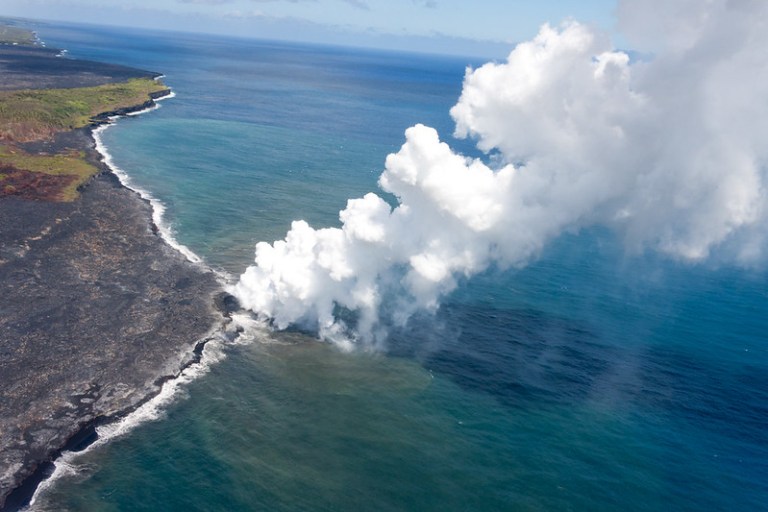
Kīlauea, pronounced like kill-uh-way-uh, is a shield volcano that erupted almost continually between 1983 and 2018.

This volcano, just as the others on the island are, is a sacred mountain in local history. In local mythology, this volcano is the body of the goddess Pele, a deity of fire, wind, and lightning.
Believe it or not, its caldera formed fairly recently, between 210,000 and 280,000 years ago.

To put the age of that volcano into perspective, Kohala, the oldest on the island of Hawai'i, is more than 500,000 years of age.

The first "tourist" to visit Kīlauea was Englishman William Ellis, who would publish the first written account of the volcano following his visit in 1823.
Kīlauea is one of two active volcanoes in Hawai‘i Volcanoes National Park, making this local landscape one of the most unique in the world.

Though this volcano is the second youngest in the Hawaiian–Emperor seamount chain, it has caused considerable damage over the years.

The surface of the volcano is covered in evidence of past eruptions, with most of the rocks on its surface dating to the last 1,100 years. Its eruptions tend to occur at its summit caldera or its eastern or southwestern rift zone. The eastern rift has been the source of its most recent activity, although that could change in the near future. As recently as 2019, its summit magma chamber was noted to be refilling with magma.
And, the future of this volcano likely includes more eruptions, as its quietest period only lasted from 1934 to 1952.

There's much to learn about our island's natural history from this young and energetic volcano.

As far as volcanoes in the U.S. go, this one is considered to be the most likely to cause destruction. From contributing to the atmosphere of the Kaʻū Desert to its prominence in Ancient Hawaiian lore, this volcano has a story to tell.
Kīlauea in the Hawaiian Islands has a story to tell, and it's one that locals and tourists alike deserve to hear. Do you remember your first visit to this powerful little volcano? Tell us about it in the comments!
Love the local landscape? Visit Thurston Lava Tube for beauty that will drop your jaw to the floor.
Subscribe to our newsletter
Get the latest updates and news
Thank you for subscribing!