America’s Sticky Obsession—Why We Love (and Loathe) Bubblegum Alley
From San Luis Obispo to Seattle, these sticky shrines turn chewed-up wads into collaborative art—and tourist magnets.
Squeezing through the 15-foot-tall narrow passageway in San Luis Obispo, I try to make my body as small as possible. I hold my arms close to my body. I shuffle sideways.
Neither move is really necessary—Gum Alley, just off the popular Higuera Street in the central California town, is certainly wide enough to avoid touching the vibrant, multi-hued lumps tacked on the walls. But I'm not taking any chances. The wads, some drippy like candle wax, both attract and repel me.
So I scrunch myself as small as possible, and then, of course, I take a few selfies.
I'm certainly not the first visitor to this sticky shrine. And I won't be the last.
From Gum to Gum Walls
Typically, the lifespan of a piece of gum is no more than a few hours—a day, max—before the used wad is flicked into oblivion. But in a few hideaways across the U.S., these chunks achieve infamy. These are gum walls: sturdy, tall, and entirely encrusted, scattered across America like technicolor tributes to collective deviant behavior.
The origins of this alley in San Luis Obispo is vague: some say it was the result of a rivalry between the local high school and California Polytechnic State University. Others say the tradition started with a graduating class event after WWII. Either way, despite originally being thought of as a gross eyesore, the passageway is now listed as one of the Things to Do on the SLO tourism website. The site even helpfully suggests local shops like SLO Sweets to grab a gumball to add to the mix.
Gum Walls Origins: '90s Seattle
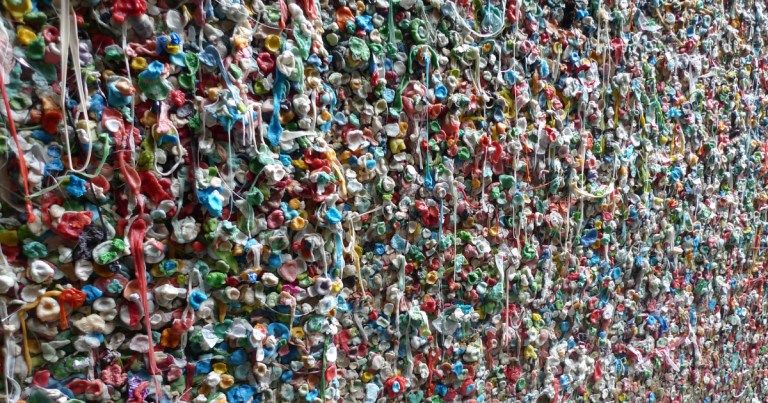
Though the unassuming SLO Gum Alley is certainly a novelty, it probably isn't the first landmark that springs to mind with the mention of a gum wall.
That honor no doubt goes to Seattle’s Pike Place Market, which houses a gummy tunnel so colorful it looks like something out of a Willy Wonka fever dream. It’s so well-known in fact, that it has its own documented oral history. As the story goes, the wall sprung up spontaneously around 1991 as visitors waited in line for Unexpected Productions Improv Comedy shows at the adjacent Market Theater. (This was the same year as Nirvana's Nevermind—perhaps it's no coincidence that grunge and this grime appeared at the same moment.)
And Yet, The Gum Wall Persisted

Like in San Luis Obispo, Pike Place Market’s management ordered multiple takedowns shortly after its genesis, but the gum wall persisted. Still, pressure-wash cleanings are needed to prevent erosion of the walls, so since 2015 there have been regular sanctioned cleaning intervals. But none have been so hefty as that first 2015 cleaning of the 50-foot section, which made the front page of the New York Times, taking 130 hours and removing 2,350 pounds of gum from the famous alley. For those counting, that’s more than an actual ton.
Today, the theater remains operational and continues to host improv, though the gum alley has arguably eclipsed the shows in fame. The vivid surfaces have become sought-after backdrops for everything from performance art to Instagram shots: look into the camera, blow the perfect pink bubble.
—
Gum Walls: Living Art Installations

San Luis Obispo and Seattle’s gum walls are designated tourist attractions, now marketed as novelties for outsiders. But a third location proves that a gum wall can actually build community. It’s also the oldest on this list, and in a far more unexpected location: Greenville, Ohio. Here, on the red brick of The Maid-Rite Sandwich Shoppe, purveyor of affordable loose-meat sandwiches, wads of Wrigley’s, Bazooka and Bubble Yum have served as the backdrop for everything from celebrating engagements to family photos and special moments. During World War II, young men took their girlfriends to the Maid-Rite to stick their gum on the wall together, before heading to war. Established in 1934, the gum wall appeared at some vague point a few years after, which also makes it nearly nine decades old. As they say on their site, "We don't really know why the gum started but it's here to stay."
Gum walls most likely started simply because of the novelty and rise of bubble gum itself, invented in 1928 and way more interesting to look at than the previous white wads. But that doesn't explain the real mystery: Why do they still exist? Furthermore, what compels us not only to seek out these glorified petri dishes, but to participate in their creation—to chew our own lumps and press it until it stays, adding our contribution to the grotesque collage?
Bubblegum Alleys As Collaborative, Public Art
Bubblegum alleys are public health nightmares, sure, but also beloved roadside attractions, and shared folk art. Fancy yourself an artist but lack any real skills? Gum walls are the perfect solution—just pick a spot and add to the work alongside your fellow gum virtuosos. Unlike museum pieces where you're only a passive observer, these accessible walls are malleable, spark the imagination, and invite interaction. Come one, come all, both to participate and enjoy.
Bubblegum Alleys: Somewhat Legal Vandalism
And then there's the thrill. Gum walls occupy a sneaky gray area between civic transgression and tolerated public art—the rush of petty crime without the consequences. You're a graffiti vandal, no, a street artist, and your work may live forever as the background to someone's Instagram portrait one day. Which brings us to…
Bubble Gum Alleys: Ephemeral—But You’re Free to Make Your Mark

The gum wall is both permanent and impermanent. Sure, your electric blue contribution will likely be scraped away in the next cleaning or buried beneath other deposits, but you've added your piece to an evolving artwork that has existed for years and will continue long after your visit. And with this ephemerality comes freedom. There's no pressure to create a masterpiece that will last forever, yet you're guaranteed a moment of creative collectivity in a quirky cultural landmark. Your gum becomes part of a story bigger than itself, an ever-changing canvas that's both deeply personal and completely anonymous.
Looking for a place to start? Seattle's Pike Place Gum Wall's last cleaning, it’s first in five years, was in 2024— there should still be plenty of room to find the perfect spot. That is, if you can stomach getting close enough.
Subscribe to our newsletter
Get the latest updates and news
Thank you for subscribing!