North Carolina Is Home To One Of The Best Astronomy Research Facilities In The World
Pisgah Astronomical Research Institute (PARI) in North Carolina offers world-class stargazing and educational opportunities with its historic NASA-built radio telescopes.
What world is this where we can observe stars that are 4.3 light years away? The Pisgah Astronomical Research Institute (PARI) makes it possible, sitting in the Pisgah National Forest in Rosman, North Carolina. Its important history dates back to 1963 when NASA opened the Rosman Tracking Station there for its isolated location as one of the two best-equipped stations in NASA’s Spacecraft Tracking And Data Acquisition Network. As a result, Rosman played a vital role in the space program, communicating with manned space flights and satellites as they passed over the East Coast. And in 1981, the Department of Defense started using the site for collecting satellite data and intercepting Russian satellite communications throughout the Cold War. Can you imagine something so important stationed in the beautiful, North Carolina mountains? In 1995 the DOD stopped operations there; fortunately, in 1998, the 200-acre facility was acquired by new owners, and PARI was born.
When you first set eyes on PARI, it’s hard to miss the NASA-built radio telescopes adapted for precision tracking of celestial radio sources using multiple frequencies.
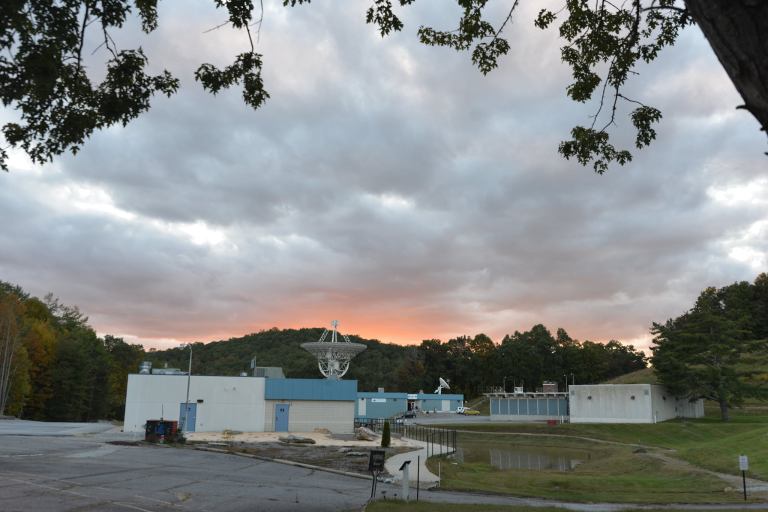
The principal radio research instruments are two 26-meter radio telescopes, and a 4.6-meter radio telescope named Smiley, coined during the Cold War.
This gigantic, 26-meter (85-foot) radio telescope is one of the few internet-controllable radio telescopes in the world.

These alone bring sightseers from far and wide.
And at sunset, when the light goes out, more visitors come.

Up and up they travel with anticipation for the sights awaiting in the night sky.

At an observation deck, a stargazer gets an early start.

PARI offers a variety of research-grade radio and optical telescopes, space, and science instruments available for use by educators, researchers, and students.

A 5-inch refractor optical telescope is ready to go.
As is the 25-inch optical reflector telescope. This is just one of 10 in PARI's collection of telescopes with a variety of focal ratio and mirror sizes.

And through it, magic happens.

While this is a current photo, in 1967, the western 26m radio telescope received NASA’s first color photo of the full Earth from space.

What planets, asteroids, space rocks, comets, meteoroids, and stars might you see?

It seems there is a sky-full tonight.

Or go inside, as PARI offers field study, space, and STEM summer camps.

The 2023 summer season will offer four summer camps.
Take yourself or a group on an adventure with a PARI astronomer for a guided journey of the final frontier. Book a cabin for a longer stay, especially during the fall to catch the prime leave-changing season. Whatever your desire, witness history at the Pisgah Astronomical Research Institute, one of the best astronomy research facilities in the world.
Subscribe to our newsletter
Get the latest updates and news
Thank you for subscribing!