These 7 Strangest Buildings in Minnesota Are Unlike Anything Else Around
Discover the strangest buildings in Minnesota, from a house made of foam to a restaurant shaped like a fish. Explore 7 architectural oddities you have to see.
The Minnesota landscape is generally reliable. You can count on the horizon line of the prairie, the vertical rhythm of the Northwoods, and the grids of the cities. But every so often, the architecture takes a sharp, inexplicable turn. I’m not just talking about unique designs: these are truly some of the strangest buildings in Minnesota—structures that seem to have been dropped into the wrong movie set. From mushroom-shaped dwellings to gas stations that belong in a museum, these seven buildings disrupt the scenery in the best way possible.
1. The Big Fish Supper Club - Bena
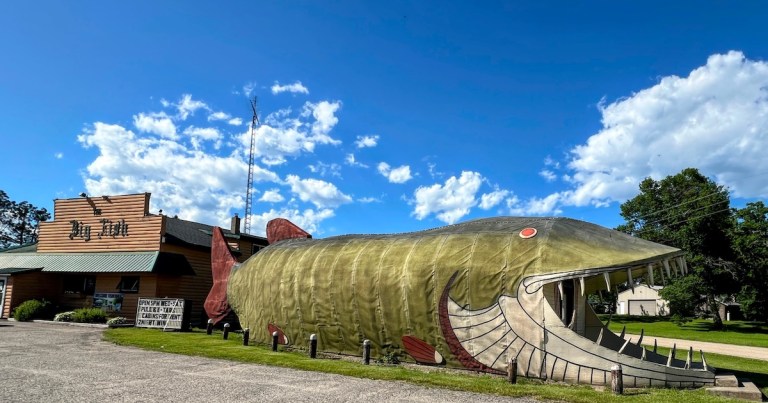
Roadside architecture usually screams for attention, but rarely does it try to swallow you whole. The Big Fish Supper Club in northern Minnesota is exactly what it claims to be: a 65-foot-long wooden muskie with an eatery inside its belly. Constructed in 1958, the Big Fish is the apex of zoomorphic design—buildings shaped like animals. Although the fish structure is used primarily for storage now—you dine in the adjacent cabin-shaped supper club—it’s a piece of unapologetic 1950s Americana that reflects the obsession of the Northwoods fishing culture, freezing the rush of the big catch into a permanent monument.
2. Civil Engineering Building - Minneapolis

Most skyscrapers race for the clouds; this one digs for the core. Located on the University of Minnesota's Minneapolis campus, the Civil Engineering Building is an "inverse skyscraper" that extends seven stories down into the bedrock, reaching a depth of 110 feet. Built in 1983 to preserve the open space of the campus mall above, 95 percent of the building is underground. To prevent the students and researchers inside from feeling like moles, the designers installed a complex system of heliostats—massive mirrors and lenses—that track the sun and beam natural light into the subterranean depths. Standing on the surface, you see only a small brick rotunda, completely unaware of the massive, hidden fortress of concrete and steel operating beneath your feet.
3. Mushroom Building - Dassel

There is no need for a metaphor here: this building in Dassel is a giant toadstool. Originally built in 1931 by Louis Belin, the structure consists of a thick central stem supporting a bulbous, red-shingled cap. While it has served variously as a gas station, a bank, and a community center, the function has always played second fiddle to the form. It sits on the roadside like a prop from a fantasy novel, utterly out of scale and context with the surrounding small-town landscape. It's a delightfully bewildering piece of weird architecture in Minnesota that refuses to be taken seriously.
4. Weisman Art Museum - Minneapolis

Driving along the Mississippi River near the University of Minnesota, your eye is inevitably snagged by a chaotic explosion of steel. The Weisman Art Museum, designed by Frank Gehry, doesn't sit on the bluff so much as it erupts from it. The stainless steel facade is a collision of curves, crags, and angles that reflect the harsh Minnesota sun in blinding flashes. It looks like a car crash in slow motion, or perhaps a block of ice shattering. It is an aggressive, restless building that makes the university's brick-and-mortar tradition look positively sleepy by comparison.
5. R.W. Lindholm Service Station - Cloquet

In a world where gas stations are universally ugly, utilitarian boxes, the Lindholm station in Cloquet is a shock to the system. Designed by Frank Lloyd Wright in 1956, it was his attempt to elevate the mundane task of refueling into a high-culture event. The station features a dramatic, cantilevered copper canopy that juts out like a spear tip, and a glass-enclosed observation lounge where Wright imagined drivers would sip coffee and socialize. It's a lingering remnant of his utopian Broadacre City concept—a retro-futuristic vision where even a pit stop was supposed to be beautiful.
6. St. John's Abbey Church - Collegeville

Approaching St. John’s Abbey in central Minnesota, you're met not by a steeple, but by a shield. Marcel Breuer’s Brutalist masterpiece is dominated by a massive, 112-foot concrete "bell banner"—a slab of gray weight that acts as a holy aegis. The church behind it’s a fortress of theology, stripping away the delicate ornamentation of traditional Catholicism in favor of sheer power and volume. The interior is bathed in a honeycomb of colored light, but the exterior remains stark and imposing. It is architecture as authority, demanding awe through massive scale and the unforgiving nature of concrete.
7. U.S. Bank Stadium - Minneapolis

The home of the Minnesota Vikings looms over downtown Minneapolis like a parked Star Destroyer that's been compared to a Jawa transport (end of Star Wars descriptors). It's a brooding, jagged mountain of black zinc and glass that seems to have landed rather than been built. While most stadiums try to mimic traditional ballparks, this one embraces a villainous, crystalline aesthetic. Its prow juts toward the skyline, and its translucent roof manages the impossible task of feeling open to the sky while keeping the sub-zero temperatures at bay. It's polarizing, dark, and undeniably dominant—a piece of civic armor built to withstand the worst the north (and the Packers) can throw at it.
These structures remind us that the built environment doesn't always have to be polite. Whether it's a fortress buried seven stories underground or a cathedral of concrete, the strangest buildings in Minnesota are also the ones that take a risk. They disrupt our sight lines and force us to look up (or down), proving that even in a state known for its reserve, there's plenty of room for the radical. Explore more of the Land of 10,000 Lakes with Only In Your State’s itinerary planner.
Subscribe to our newsletter
Get the latest updates and news
Thank you for subscribing!